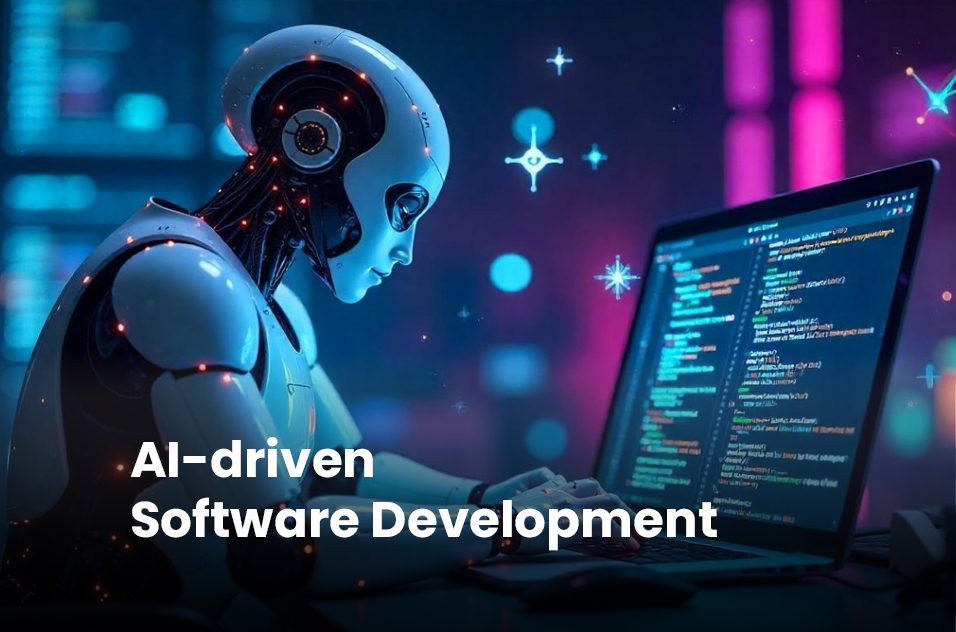
Artificial intelligence has rapidly moved from being a cutting-edge research topic to a foundational element of modern software. Today, AI-driven systems are reshaping industries, automating workflows, and augmenting human capabilities across every sector. But as impressive as AI applications appear from the outside, the biggest transformation is happening inside the world of software development itself. AI is no longer just something we build into software—it is becoming a collaborator, a designer, and even a co-developer.
The shift toward AI-driven software is rooted in the growing demand for speed, scalability, and automation. Traditional development cycles often involve repetitive coding, rigorous testing, debugging, user analysis, and optimization. These processes take time and require significant human resources. AI can streamline many of these tasks, allowing development teams to build more advanced software faster than ever before.
One of the most impactful innovations has been the emergence of AI-assisted coding tools. Modern code assistants can understand human instructions, generate functions, detect bugs, and even refactor entire codebases. These tools don’t replace developers; instead, they enhance productivity by handling tedious tasks. Developers can focus on creative problem-solving while AI proposes solutions, manages boilerplate code, and ensures consistency across large projects. As these tools continue to improve, coding may become more about describing the desired outcome than writing individual lines of code.
AI is also revolutionizing software testing and quality assurance. Traditional testing requires creating test cases, executing them manually or through automated scripts, and analyzing results. AI-powered testing platforms can automatically generate test cases, predict high-risk areas, and detect defects earlier in the development cycle. Machine learning models analyze patterns from previous failures to anticipate future issues. This results in faster releases and more reliable software. Intelligent testing is especially valuable for complex applications where manual testing would be too slow or incomplete.
Another area driven by AI is software personalization. Modern users expect experiences tailored to their preferences, behaviors, and needs. AI algorithms enable adaptive user interfaces, personalized recommendations, dynamic workflows, and predictive features. For example, AI can analyze how users navigate an application, then optimize layouts, suggest shortcuts, or automate frequently repeated actions. This real-time personalization significantly enhances user satisfaction and engagement.
AI also plays a powerful role in data-driven decision-making. Many modern software platforms rely heavily on analytics to understand user behavior, optimize performance, and improve products. AI enhances these capabilities through predictive analytics, anomaly detection, trend forecasting, and intelligent insights. Product teams can make data-backed decisions with unprecedented speed and accuracy. Instead of guessing what users want, companies can rely on AI to reveal patterns and guide development roadmaps.
Automation is another cornerstone of AI-driven software. Traditional workflows—such as provisioning servers, configuring environments, deploying updates, and managing infrastructure—once required manual intervention. Today, AI-powered DevOps tools can automate these operations. Intelligent pipelines detect when new code is ready, run tests, deploy builds, monitor performance, and roll back changes if issues arise. This reduces downtime, improves reliability, and supports continuous delivery. The future may see fully autonomous DevOps systems where human oversight is required only for critical decisions.
The rapid advancement of AI also introduces new challenges. One major concern is model transparency and ethics. AI-driven systems often function as “black boxes,” making it difficult to understand how decisions are made. This lack of transparency can cause issues in regulated industries like finance, healthcare, and government. Developers must incorporate explainability frameworks, fairness checks, and responsible AI practices into their software. Ethical development will be essential as AI becomes more deeply integrated.
Security is another major consideration. While AI strengthens cybersecurity through threat detection and automated responses, it also introduces new risks. Attackers can exploit vulnerabilities in AI models, manipulate training data, or generate malicious code using AI tools. Software teams must implement robust safeguards, including adversarial testing, monitoring, and secure model deployment.
Despite these challenges, the future of AI-driven software is incredibly promising. We are entering an era where intelligent systems will participate in every stage of development—from planning and coding to deployment and maintenance. As these tools mature, they will enable developers to build more sophisticated applications in a fraction of the time, unlocking new opportunities for innovation.
AI is not replacing the role of human developers—it is evolving it. By automating repetitive tasks and providing powerful insights, AI allows developers to focus on creativity, architecture, and complex problem-solving. This collaboration between humans and machines represents a new chapter in software development—one that blends intelligence, automation, and innovation into a seamless workflow.
The rise of AI-driven software is reshaping the industry, empowering teams to build smarter, faster, and more adaptive applications. As AI continues to advance, its role in development will only grow, marking the beginning of a truly intelligent software era.